Welcome!
A little background to this blog:
What are Genetically Modified Organisms really?
GMOs are organisms in which a part of their genetic code has been changed to create that organism with a new, desired characteristic.
Check out this video from DNews about glow in the dark animals!!
The process of genetic modification or engineering is when new genetic traits are introduced to said organism, plant or animal through reproductive cloning or the use of recombinant DNA technology (Fridovich-Keil, 2013).
Reproductive cloning is when an identical copy of a cell or organism's genetics is created by inserting a cloned embryo into a real or artificial uterus or by inserting a nucleus from one somatic (body) cell of an organism into an egg whose nucleus had been removed (Rugnetta, 2014). Cloning can occur naturally in nature through asexual recombination, binary fission and budding but can also be replicated and modified using scientific techniques.
Recombinant DNA technology refers to the process of taking a specific gene from one organism and inserting it into the chromosome of another organism. It then can go through the process of replication and the new gene becomes a part of that organism’s genetic material that can be passed on to further generations (Griffiths, 2013).
For more information and further explanation feel free to click here!
Here is a link to a timeline that gives you a good overview of the history of GMO regulations if you’re interested. It also has references posted at the bottom for further inquiry!
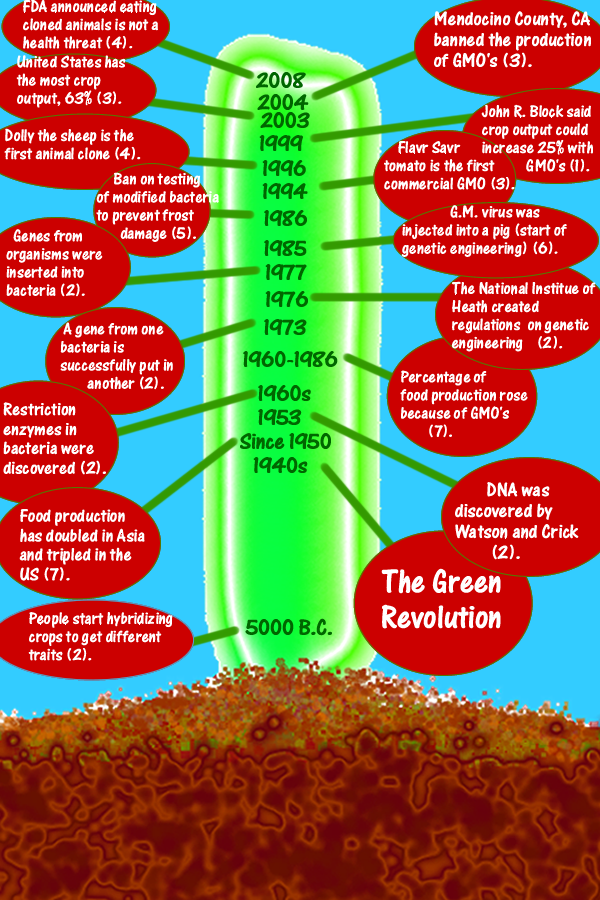
There’s a lot of debate whether GMOs are good or bad and if they should continue to be researched and used or not. It seems that the majority of information in the media and mainstream society deems genetically modified organisms as a terrible travesty that should be stopped immediately.
So here are some concerns about the effects of GM crops:
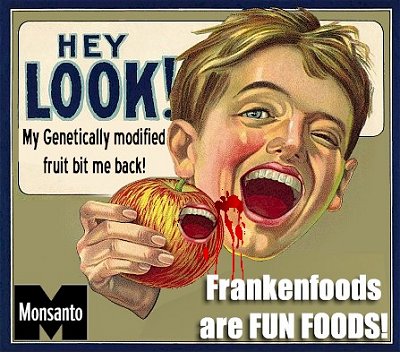
There is definitely a ton of articles and groups out there that are in fervent opposition to the use of genetically modified crops. There are a multitude of FaceBook pages, news articles, journals, blogs, tweets, photos, propaganda and anything of the like preaching about how terrible GMOs are.
http://www.nongmoproject.org/press/blog/
http://www.foxnews.com/health/2014/02/27/health-myth-are-gmos-actually-bad-for/
http://www.foxnews.com/health/2014/02/27/health-myth-are-gmos-actually-bad-for/
#DavidSuzuki OBC PhD Geneticist
"Any politician or scientist who tells you these #GMO products are safe is either very stupid or lying"
— Dr. Vandana Shiva (@drvandanashiva) May 7, 2014
Barack Obama and the Monsanto betrayal. http://t.co/a8epldPCKK #GMO
— Jon Rappoport (@jonrappoport) May 8, 2014
Much higher than expected levels of RoundUp have been found in #GMO soy sold is the US http://t.co/1UacghMgKZ
— Just Label It (@justlabelit) May 5, 2014
The Institute for Responsible Technology composed an article listing their reasons to avoid GMOs.
Those reasons are:
1. GMOs are unhealthy - some animals studies reviewed by the American Academy of Environmental Medicine showed organ damage, gastrointestinal and immune system disorders, accelerated aging, and infertility. They also worry about the long-term effects of GMOs in humans.
2. GMOs contaminate-forever - Since genetically modified plants can still cross pollinate with non-GMO plants, the genetically modified plants can continue to spread their genetic changes to other plants.
3. GMOs increase herbicide use - The article states that between 1996 and 2008, 383 million more pounds of herbicides were used by US farmers.
4. Genetic engineering creates dangerous side effects - the believe that mixing genes of totally unrelated species can result in new toxins, allergens, carcinogens and nutritional deficiencies.
5. Government oversight is dangerously lax - the biggest concerns they stated here were the lack of regulations and mandatory testing of the GMOs and that labeling of GMO products is not required.
6. The biotech industry uses "tobacco science" to claim product safety - the same research methods that were used to give us results about the safety of Agent Orange, PCBs, and DDT are now being used to test the safety of GMOs.
7. Independent research and reporting is attacked and suppressed - scientific journals and media are being censored and studies showing negative impacts of GMOs are being unfairly picked apart.
8. GMOs harm the environment - GM crops and their associated herbicides can harm birds, insects, amphibians, marine ecosystems and soil organisms.
9. GMOs do not increase yields, and work against feeding a hungry world - studies reviewed in The International Assessment of Agricultural Knowledge, Science and Technology for Development report showed that crops yields were "highly variable" and in some cases "yields declined."
10. By avoiding GMOs, you contribute to the coming tipping point of consumer rejection, forcing them out of your food supply - if consumers refuse to buy enough GMOs then they will get kicked out of the market.
(Institute for Responsible Technology)
Now, one MAJOR thing I would like to point out here, especially when you go look at the article, is that these are very overgeneralized statements with, seemingly, not a lot of actual information to back it up. They do tell where some of their information has come from but provide no actual references for us to double check.
When researching GMOs you'll tend to come across this issue a lot and I have to tell you, if you want to know the TRUTH, then you're going to have to dig into some scholarly scientific writings to find your real answers.
That can prove to be difficult though.
I did manage to find many scientific studies on genetically modified crops and their effectiveness.
Most of them stated that there were possibilities of long term issues that have not yet been determined.
That seems to be the key term I've found in all of my research.
Short term studies show varying results in the harmful effects of these GM crops but I haven't yet come across any conclusive information on the long-term effects.
One study showed that rats fed with GM soybean and maize over a 90 day period resulted in data that lead to the belief there were liver and kidney problems due to the genetically modified diet. Again, though, the report states that it cannot draw sufficient conclusions about chronic toxicity of GM crops from this study and urges that further studies be conducted and made mandatory to determine such an outcome (Séralini, et al).
Another study I came across addressed the issue of sustainability of crops in the Midwest.
The overall study is actually pretty easy to read through and if you're really interested or don't believe my upcoming summary of it I highly suggest you read through it!
The main conclusions of this study were that the GM crops studied did not add significant value to yields nor to variation for protection against pathogens and the like and thus should not be relied upon as a solution for the world's need for better food production practices (Heinemann, et al, 2013).
On the other hand, here’s a little view of how GMOs could possibly benefit us:
While the media and society in general seems full-blown against GMOs, there are still supporters out there for the use of this technology.
The full scope of benefits from genetically modifying organisms is far from being completely known yet, but there are several possible qualities from that could prove to be quite favorable.
Altering the genes of crops can result in:
Larger amounts of food being produced in less amounts of space
Safeguard against pesticides
Act as pesticides in the plants themselves
Help the plants endure temperature changes not typically endurable
Help plants utilize less water and possibly improve water quality!
These benefits would then result in:
Lower food price
Less demand for water
More food available, especially when considering third world countries
A specific example includes a report prepared for the National Academies by multiple experts in pertinent fields discusses how there could be many benefits to US farmers, both economically and environmentally, through the use of GE crops “such as lower production costs, fewer pest problems, reduced use of pesticides and better yields” in addition to: improved water quality due to the reduced used of the pesticides, insecticides and herbicides; less tilling of the soil which “improves soil quality and water filtration and reduces erosion” (National-Academies.org | Newsroom, 2010).
The report also stated, though, that it is extremely important to use this technology carefully as there have been studies that show that the insects the GM crops are designed to keep away are adapting and thus the GM crops are no longer effective in their modification.
This, however, is likely to happen in nature as it is. There is most likely no single organism on this planet that has not changed and adapted since the beginning of time; nearly all organisms have had to modify themselves and adapt to their changing environments and resources to survive.
Another article about the differing views on regulation of GMOs between the United States and Europe brings up the discussion of those opposing views and how Africa might choose to respond to GMO use. Africa suffers from long periods of drought and a lack of irrigation to croplands and thus has a tough time being secure in their food production. This sub-saharan continent could benefit greatly from crops genetically modified to withstand or tolerate drought (Paarlberg, 2010).
I think that in the United States and Europe, where food is still plentiful, it can be easy to forget that's not the case for many other areas of the world and starvation from lack of decent amounts of food is a very real dilemma.
A compelling article written by Jon Entine, who is the executive director of the Genetic Literacy Project, senior fellow at the Center for Health and Risk Communication and STATS at George Mason University, concluded that if you look at the overwhelming amount of research done on this topic over the last 30 years it undeniable that there has thus far been insufficient evidence that genetically modified organisms are at all harmful to the environment or to human health. He further states that of these studies conducted and reviewed, "as many as 1000....have been independently executed by independent scientists" (2013).
Here are a few more articles and studies done explaining not only our need for genetically modified crops as time progresses but also the safety of these foods and organisms:
Q and A about Genetically Modified Crops
The Release of Genetically Modified Crops into the Environment
Genetically Modified Crops
Why We Will Need Genetically Modified Foods
The Bottom Line:
When I started my research into this topic I, much like a grand majority of the public seems to be, was under the grand impression that GMOs are terrible for you and for the environment and that the public was being kept in denial about all the negative effects that they're causing.
Now, after reading numerous studies and, of course, blogs and articles, I feel like I'm just as lost as many of the scientists seem to be on the topic!
I can see where there could be some theoretically amazing aspects to this form of technology.
I think I support the continued research in this area, for those reasons.
However,
I do wish the US government would take more of an active role in the regulation of GMOs and would be a little more wary of just "trusting" that there will be no long-term, negative impacts from the use of this technology.
The European Union has a pretty strong standpoint of not incorporating GM foods into their markets but support the study of them.
I think there is a TON of misinformation out there and that people these days are willing to believe nearly anything they see and hear without checking the facts first.
Take this article about a baby dinosaur being cloned for example!

Well for starters, don't listen to me. Or the media. Or that friend who's telling you all those "facts" about GMOs. Do a little research of your own! Make your own conclusions and then you can make informed decisions from that point!
Two places you could start:
http://gmoanswers.com/ask/are-gmos-bad-for-people-enviroment - this will take you to a Q&A forum where many questions you might have could already be answered or you can submit your own! The responses tell you who is responding to you and you can then look up that person to determine if they seem credible or if they might be phony.
http://www.gmo-compass.org/eng/home/ - When in doubt, turn to Europe! Okay, maybe not for everything but they do have a pretty well organized site for researching GMOs with tons of videos, links, articles and databases for you to fill your leisurely time with!
And of course, use as many of the links and references I posted and maybe you can scour them for more useful information that I was able to do!
At the right side of the page should also be links to help you perform your own scholarly searches, should you be interested.
Stay tuned, granted I have the time, I might post more on GM animals, medicines, and the labeling issue!
Please share your thoughts and questions!
References
- Entine, J. (2013, October 14). 2000+ Reasons Why GMOs Are Safe To Eat And Environmentally Sustainable. Forbes. Retrieved May 5, 2014, from http://www.forbes.com/sites/jonentine/2013/10/14/2000-reasons-why-gmos-are-safe-to-eat-and-environmentally-sustainable/
- Fridovich-Keil, J. (2013, December 25). genetically modified organism (GMO). Encyclopedia Britannica Online. Retrieved May 5, 2014, from http://www.britannica.com/EBchecked/topic/897705/genetically-modified-organism-GMO
- Genetic Engineering Benefits. (n.d.). Genetic Engineering Benefits. Retrieved May 5, 2014, from http://www.geneticengineeringinhumans.com/ar/genetic-engineering-benefits.php
- Griffiths, A. (2013, May 16). In vitro mutagenesis. Encyclopedia Britannica Online. Retrieved May 5, 2014, from http://www.britannica.com/EBchecked/topic/493667/recombinant-DNA-technology/271855/In-vitro-mutagenesis#toc271856
- Heinemann, J., Massaro, M., Coray, D., Agapito-Tenfen, S., & Wen, J. (2013, June 14). Sustainability and innovation in staple crop production in the US Midwest. Taylor and Francis. Retrieved May 5, 2014, from http://www.tandfonline.com/doi/full/10.1080/14735903.2013.806408#tabModule
- Institute for Responsible Technology. (n.d.). - 10 Reasons to Avoid GMOs. Retrieved May 7, 2014, from http://www.responsibletechnology.org/10-Reasons-to-Avoid-GMOs
- National-Academies.org | Newsroom. (2010, May 13). National-Academies.org | Newsroom. Retrieved May 5, 2014, from http://www8.nationalacademies.org/onpinews/newsitem.aspx?RecordID=12804
- Paarlberg, R. (2010, November 30). GMO foods and crops: Africa's choice. Science Direct. Retrieved May 6, 2014, from http://www.sciencedirect.com/science/article/pii/S1871678410005145
- Parsley, L. (n.d.). Transgenic Plants: A Budding Controversy Stems from Consumer Concerns | JYI – The Premier Undergraduate Research Journal. JYI The Premier Undergraduate Research Journal. Retrieved May 5, 2014, from http://manage.jyi.org/issue/transgenic-plants-a-budding-controversy-stems-from-consumer-concerns/
- Rugnetta, M. (2014, January 24). cloning (genetics). Encyclopedia Britannica Online. Retrieved May 5, 2014, from http://www.britannica.com/EBchecked/topic/962695/cloning (
- Séralini, G., Mesnage, R., Clair, E., Gress, S., de Vendômois, J. S., & Cellier, D. (2011, March 1). Genetically modified crops safety assessments: present limits and possible improvements - Springer.Genetically modified crops safety assessments: present limits and possible improvements - Springer. Retrieved May 7, 2014, from http://link.springer.com/article/10.1186/2190-4715-23-10#page-1
